


News Center
Industrial robot safety risk and protection upgrade strategy
2024-12-02 09:00:00
Click:
“
Industrial robot is a multi-joint manipulator or multi-degree of freedom machine device widely used in the industrial field, with a certain degree of automaticity, can rely on its own power energy and control ability to complete a variety of complex industrial production tasks.
”
Industrial robot is a multi-joint manipulator or multi-degree of freedom machine device widely used in the industrial field, with a certain degree of automaticity, can rely on its own power energy and control ability to complete a variety of complex industrial production tasks. Compared with traditional industrial equipment, industrial robots have been widely used in various industrial fields such as electronics, automobiles, food processing, packaging, logistics, chemical industry, etc. by virtue of their advantages of ease of use, high intelligence level, high production efficiency, easy management and significant economic benefits.

Industrial robots play a vital role in modern manufacturing, however, while enjoying the high-speed operation of robots and improving production efficiency, security risks are also quietly brewing. In the automated production process, the collaborative work of robots and humans has become the norm. In a busy and complex environment, people's lack of awareness of workshop safety risks is easy to induce new safety risks, and even further evolves into a major safety accident.
Industrial robot safety risks
The national standard GB11291.2, in the "List of Major Hazards for Robots and robotic Systems", divides the potential consequences caused by dangerous situations in robots into the following 10 types:
1. Mechanical hazards: squeezing, shearing, cutting or cutting, entanglement, dragging or trapping, collision, puncture or puncture, friction, wear, injection or injection of high pressure fluid/gas.
2. Electrical hazard: electrocution death, electric shock, burn, spray of melted particles.
3. Thermal hazards: burns (hot or cold), radiation damage.
4. Noise hazards: loss of hearing, loss of balance, loss of consciousness, disorientation, surroundings or any other (e.g. mechanical) consequence of distraction.
5. Vibration hazards: fatigue, loss of nerves, cardiovascular disease, stamping.
6. Radiation hazards: burns, skin and eye damage, related diseases.
7. Material hazards: sensitization, fire, chemical burns, inhalation diseases.
8. Ergonomic hazards: poor posture or excessive effort (repetitive overwork).
9. Hazards related to the environment in which the machine is used: burns, diseases, slippage, falls, respiratory damage, impact.
10. Multi-factor hazard: Any other consequence of a combination of multiple factors or a hazardous situation.
According to the safety theory, these potential consequences are mainly caused by two unsafe factors, one is the unsafe behavior of people, and the other is the unsafe state of things.
Two elements that cause security risks
Human unsafe behavior usually refers to the behavior caused by human mistakes, negligence, violation of operating procedures or safety systems. The unsafe state refers to the defects, aging, wear or failure of equipment, facilities, tools or raw materials during production or use. There is a strong correlation between these two unsafe factors, which can easily lead to accidents when they act alone or together.
1. People's unsafe behavior
For example, production accidents caused by weak safety awareness of personnel. When individuals or teams lack adequate safety alertness and awareness, they may ignore potential hazards, thus increasing the likelihood of accidents. Industrial production is repetitive and monotonous work, some employees in a position for a long time, thinking that they are familiar with the process, ignore the operating norms, eager to succeed, and even deliberately violate, this behavior is very easy to cause production safety accidents.
2. The unsafe state of the object
For example, mechanical injury accidents caused by equipment wear failure or inadequate safety protection. When the moving parts of industrial robots are running at high speed, if the equipment fails or the safety protection is not in place, it may lead to mechanical injuries such as pincers and collisions. Such injuries often occur within the scope of the robot's work, and if the operator does not comply with safety norms and strays into dangerous areas, it may suffer injury.
Accident case
What are the possible consequences of unsafe conditions for people or things? It may not be easy to make a strong impression with words alone. Next, let's review those shocking accident scenes through a group of GIFs, which will intuitively reveal the significance of the "human and object safety state".
Accident case 1: The operator accidentally strayed into the robot operation area and was crushed and died on the spot.

Accident case 2: There is no safety fence in the working area of the robot, and the operator is not safe to stand, and is crushed to death by the robot arm.
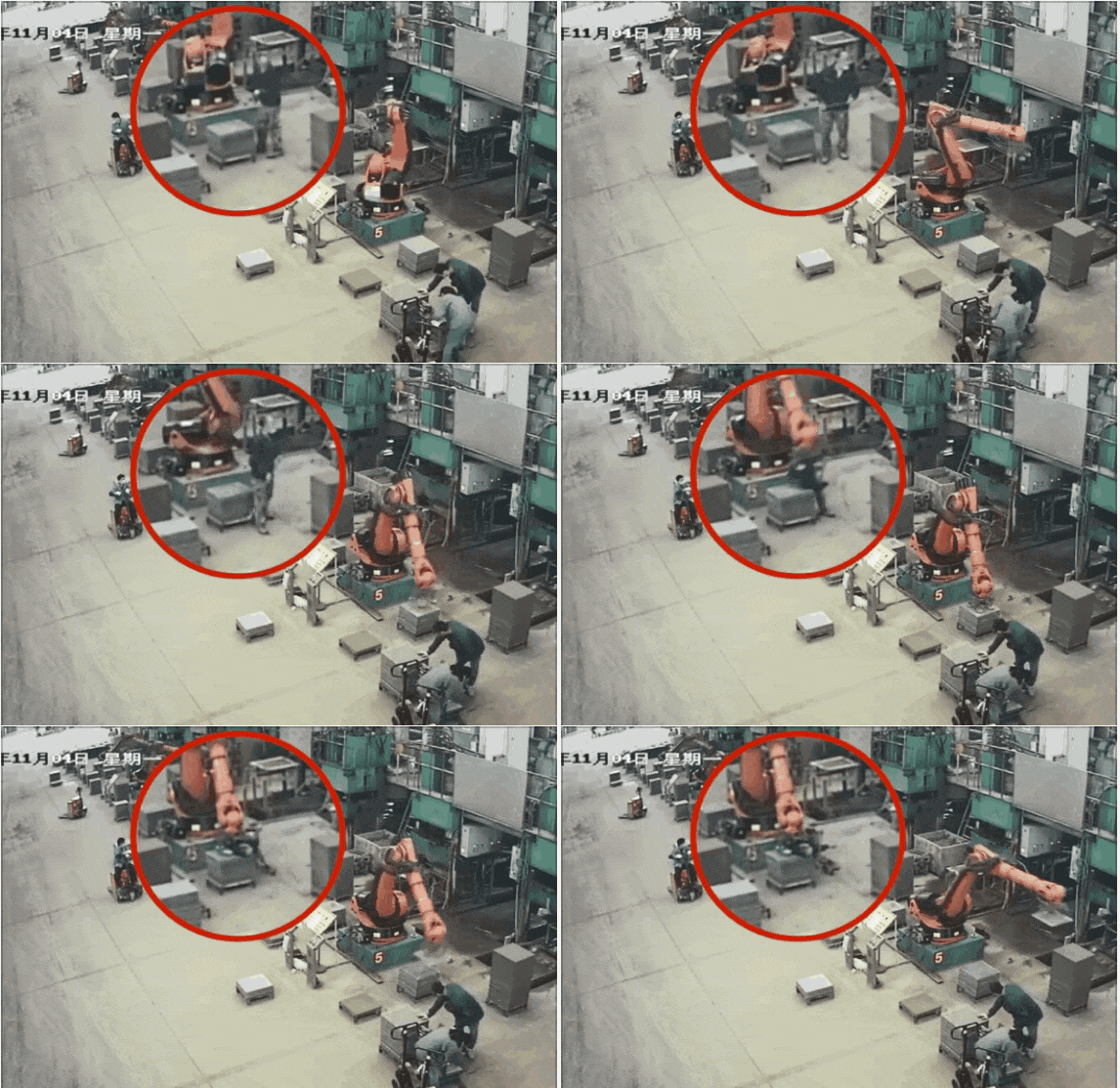
Accident case 3: The operator illegally entered the activity area of the palletizing equipment and was crushed by the robot and died on the spot.

Industrial robot safety protection measures
Safety accidents often occur in dangerous areas where human working space and mechanical working space overlap. The basic principle of preventing mechanical injury is to block unsafe factors and ensure the safety of robot operating conditions. Therefore, the safety protection measures of industrial robots can be started from two aspects: to eliminate the unsafe behavior of people and to eliminate the unsafe state of things.
Measures - to eliminate unsafe human behavior
From the perspective of production safety, eliminating people's unsafe behavior is an important link to ensure the smooth production process and the personal safety of employees. The following elimination measures can be used:
Action 1: Strengthen safety education and training
Pay attention to systematic safety education for employees, including safety production laws and regulations, safety operation procedures, accident case analysis and so on. Through repeated education and training, so that employees gradually form the correct safety awareness, master the necessary safe operation skills, to avoid illegal operation in the production process, neglect of safety and other behaviors.
Measure 2: Improve the safety management system
Establish a sound safety management system, clarify the safety responsibilities and authority of personnel at all levels, and standardize the behavior of employees in the production process. At the same time, it is necessary to strengthen the supervision and inspection of the safety management system to ensure that the system is effectively implemented. Violations of the safety management system should be corrected and punished in a timely manner to make an example of others.
Measure 3: Implement reward and punishment incentive measures
Through the establishment of a safety reward system, employees who have outstanding performance in the production process and comply with safety regulations are commended and rewarded to stimulate their work enthusiasm and safety awareness.
Measure 4: Create a good safety culture
Convey safety concepts, safety knowledge and safety skills to employees through publicity boards, slogans and cultural activities. At the same time, encourage employees to actively participate in safety culture activities, such as post benchmarking activities, standardized operation competitions, etc., to help employees strengthen good safety habits and behavior patterns. The implementation of these measures will help reduce safety accidents and casualties in the production process, and ensure the safety of production and the life safety of employees.
Measures - Eliminate the unsafe state of the object
Ensuring the efficient operation of industrial robots in a safe environment is an effective means to eliminate the unsafe state of objects. In principle, there are two ways to achieve this:
1. Isolation principle - the operation output of human and machinery is separated in space, that is, safety protection is carried out through safety fences, safety light curtains and other devices;
2. The stop principle - separation in time, that is, further strengthening safety protection through interlocking devices.

Measure 1: Security fence - barrier isolation
As a temporary isolation measure to prevent personnel from entering a specific area, security fences are used in combination with other devices in industrial scenarios to enhance their isolation, warning or protection functions. For example, security fences combined with LOTO signs can be used to alert people to dangers and not to enter or approach specific areas; The security fence is used in combination with an interlock switch to ensure that the fence is not opened without authorization, thus preventing people from entering dangerous areas.

Measure 2: Safety light curtain - inductive isolation
Safety light curtain is a safety protection device widely used in the field of industrial automation, especially suitable for stamping machinery, packaging machinery, automated assembly lines, robot working areas and other potentially dangerous areas of automation equipment. The safety light curtain forms one or more invisible protective barriers by transmitting and receiving infrared beams or laser beams. When the human body or object enters the area, it will immediately cut off or stop the operation of the machine, thus effectively preventing the occurrence of accidents.
Bytorent safety light curtain product line is rich, GM series covers GM1 (secondary protection) and GM2, GM3 (fourth protection) and other models, all of which have reached IP65 high-level protection standards. This series of light curtain has excellent anti-vibration, anti-electromagnetic interference and anti-light interference capabilities, excellent waterproof and dustproof performance, to ensure stable operation in a variety of harsh environments. It is convenient to install, easy to operate, simplified wiring process, and has perfect self-test function and accurate light detection, which is a cost-effective safety protection solution.

Measure 3: Safety interlock device - control isolation
The safety interlock device achieves the interlock function through the mutual restriction of mechanical or electrical equipment, which is often used for the orderly operation of industrial automation production lines or robots under specific safety conditions to prevent safety accidents caused by misoperation, equipment failure or external factors.
The safety interlock device can be used in conjunction with the safety door and realize the interlock function. When the safety door is closed and locked, the safety interlock device sends a signal to the control system of the associated equipment (such as robots, production lines, etc.). This signal indicates that the door is secure and the device can operate normally. However, once the door is opened (whether for normal operation or unauthorized entry), the safety interlock immediately sends an interrupt signal that triggers the emergency stop mechanism of the device to prevent a safety incident when personnel enter the dangerous area. There are many kinds of Bytorent safety interlocking devices, which can be used to monitor safety doors and safety Windows. Suitable for robot production lines, automated production lines, hazardous test areas, isolated places, etc., each device has its own specific application scenarios and advantages.
Electromagnetic safety interlock switch - Oxon-T3 series, with 4 forced mechanical contacts, using all-metal head and stainless steel components, can be rotated in four directions, multi-angle installation, safe and reliable.

Electromagnetic safety interlock switch - Guard-M1 series, using 304 stainless steel lock core and blade key, and V0 flame retardant grade of high-performance engineering plastics, support electromagnetic locking or mechanical locking, provide 2 contact /4 contact combination and other functions.

Compact safety switch - Monit-G1 series, its insert key entrance with a unique structural design, can prevent the opening of special-shaped tools, dual channel output to ensure higher safety system reliability. At the same time, the Monit-G1 is connected with the safety relay of the Bytorent atomic series, which can further strengthen the safety system and escort the safe production.

Conclusion: While industrial robots significantly improve production efficiency, they are also accompanied by many security risks. No matter what strategy is adopted to address the challenges of workplace safety, ensuring that people and things remain safe is the core of the solution.










Copyright © 深圳市多恩技术有限公司 All Rights Reserved. 备案号:粤ICP备17015015号
